
DEXA Scan for Body Composition: What It Shows and Why It Matters After 45
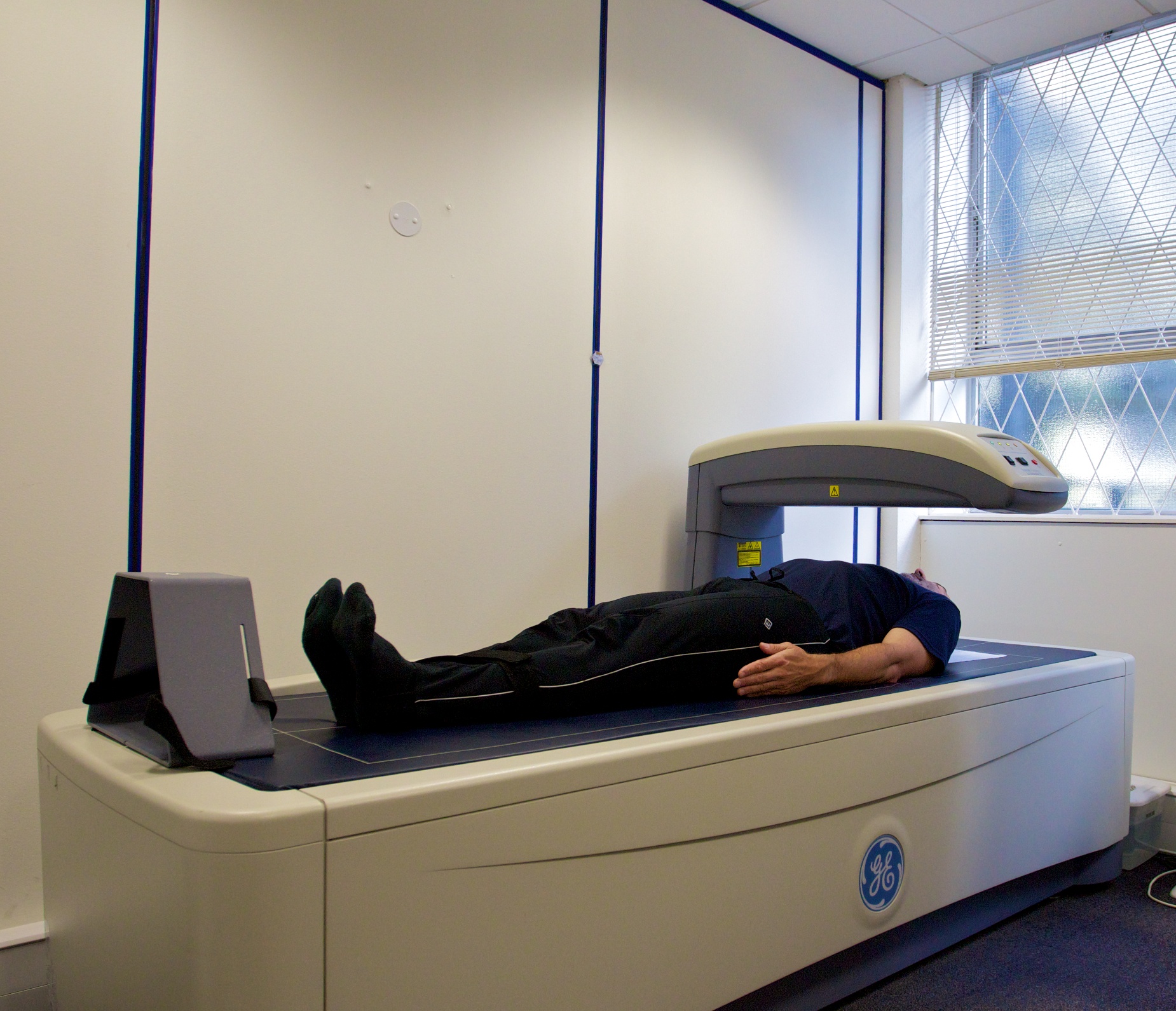
You booked a bone density scan, lay under the machine for ten minutes and came away with a report about your bones only. But what you really wanted to know was how much fat you carry, where it sits and how much muscle you have left. Sound familiar? The same machine can answer those questions too. A DEXA scan for body composition is a separate protocol, and many clinics only run it if you ask for it by name.
This guide explains what a DXA (DEXA) scan is, how the bone mode and the body composition mode differ, why body composition matters so much after 45, what you get in your report, how to make the numbers useful, and what to do if there's no scanner nearby.
What is a DEXA scan?
DXA, also written DEXA, stands for dual-energy X-ray absorptiometry. It's an X-ray device that uses two energy levels. Because bone, fat and lean tissue absorb these two beams differently, the machine can tell them apart. You lie still on a padded table while a scanner arm passes over you.
One machine, two modes: bone density vs body composition
This is the source of most of the confusion.
- Bone mode measures bone mineral density, usually at the lumbar spine and the hip. This is the classic “densitometry” used to look for osteopenia and osteoporosis.
- Whole-body mode also measures fat mass, lean (muscle) mass and how fat is distributed across different areas of the body.
In many clinics, the default is bone only. Body composition is a separate protocol, and you need to name it when you book. In English, ask for a “DXA body composition scan (whole body)”. In Spanish, composición corporal. In Russian, «денситометрия всего тела с оценкой состава тела».
A 2017 review by Shepherd and colleagues in the journal Bone put it plainly: body composition by DXA is much more than a fat percentage, and the method has been underused for years.
If bone density is what you need, read our guide to osteopenia and osteoporosis in menopause. Often it makes sense to ask about both.
Why body composition matters after 45
The scale can't tell fat from muscle
A bathroom scale shows one number: your total weight. It can't tell you whether that weight is muscle, fat, bone or water, and in midlife that distinction matters more than the total.
What the SWAN study found
In the American SWAN study (Greendale and colleagues, JCI Insight, 2019), women's body composition was measured with DXA over the menopause transition. As the transition began, the rate of fat gain doubled and lean mass started to decline. This continued until about two years after the final menstrual period. Yet total body weight didn't noticeably speed up.
In other words, the needle on the scale can stay put while, inside, muscle is gradually being replaced by fat. “It's not your character, it's biochemistry.” And that's exactly why a measurement that sees the difference is so useful.
What a DEXA body composition report shows
A whole-body scan typically gives you:
- Fat mass and body fat percentage.
- Lean mass, including your arms and legs separately. Lean mass is mostly muscle, so this shows whether you're losing muscle and where, and whether it is evenly distributed between the arms and legs.
- Fat distribution: how much sits on the trunk versus the hips and legs, the classic “apple” versus “pear” shape.
- An estimate of visceral fat, the fat stored deep inside the abdomen around the organs.
A note on visceral fat
The visceral fat figure is an estimate, not a precise measurement. In a study of 132 women with an average age of 55 (Davidson and colleagues, European Journal of Clinical Nutrition, 2020), DXA correlated well with CT scans, but it overestimated visceral fat in absolute numbers. So look at the trend over time, not at a single number.
How to make your DEXA results useful
Name the mode when you book
Say “body composition, whole body”, not just “densitometry” or “bone density”. Otherwise you may get a bone report only.
Repeat on the same machine, under similar conditions
Scanners and software from different manufacturers can give slightly different numbers. That's why your first scan is a baseline, not a verdict. For a fair comparison, repeat the scan on the same machine and under similar conditions.
Don't change treatment based on one number
Don't draw conclusions or change treatment based on a single figure. Discuss the interpretation and how often to repeat the scan with your doctor. Regular measurements fit naturally into a 12-month longevity cycle with regular testing.
What to do with the results
The numbers matter because they point to concrete levers. If lean mass is low or falling, the two most obvious levers are strength training and enough protein. Read more in how much protein women over 50 need. If fat is shifting towards the trunk, that's a reason to look more closely at metabolism with your doctor.
No DXA scanner nearby? A simple home alternative
Not everyone has easy access to a DXA scanner. A simple home routine still shows the direction of travel:
- Measure your waist and hip circumference once a quarter.
- Weigh yourself at the same time.
- Take photos in the same light.
- Do a simple strength test: count how many times you can stand up from a chair without using your hands.
This doesn't replace the scan, but you'll see the trend. “Not a crisis, but an upgrade”: you get numbers you can actually work with.
Common misconceptions about body composition
“My weight hasn't changed, so everything is fine”
The SWAN study suggests otherwise: during the menopause transition, fat can increase and muscle can decline while total weight doesn't noticeably speed up. A stable weight doesn't mean a stable body composition.
“Body fat percentage is the number that matters”
Fat percentage is just one line of the report. How much lean mass you have, how it's distributed between your arms and legs, and where your fat sits matter just as much. That's why the review in Bone stresses that DXA body composition is much more than a fat percentage.
“One scan tells me everything”
Your first scan is a baseline. The meaning appears when you have something to compare it with: a repeat on the same machine shows which way you're heading.
Frequently asked questions
What is a DEXA scan for body composition?
It's a whole-body DXA (dual-energy X-ray absorptiometry) scan that measures fat mass, lean mass and fat distribution, including an estimate of visceral fat. It's a separate protocol from the standard bone density scan and needs to be requested by name.
Is a DEXA scan the same as a bone density test?
It's the same type of machine, but a different mode. Bone mode measures bone density at the spine and hip. Whole-body mode adds fat mass, lean mass and fat distribution. Many clinics run bone mode by default.
How accurate is DEXA for visceral fat?
In a study of 132 women, DXA correlated well with CT but overestimated visceral fat in absolute numbers. Use it to follow trends over time rather than relying on a single value.
How often should you repeat a DEXA body composition scan?
Discuss the frequency with your doctor. For comparable results, repeat it on the same machine under similar conditions, and treat the first scan as a baseline.
Why does body composition change in menopause?
In the SWAN study, the rate of fat gain doubled and lean mass declined from the start of the menopause transition until about two years after the final period, while total weight didn't noticeably speed up.
The bottom line
After 45, the most important changes in your body may be invisible on the scale. A DEXA body composition scan shows what the scale can't: how much fat and muscle you have, where they are and how they change over time. Ask for it by name, repeat it on the same machine and read the trend with your doctor.
If you want measurements like this turned into a plan for training, nutrition and hormones, that is what the Personalised Method is built around.
Ready to turn your numbers into a plan? Apply for a Strategic Session.
Sources
- Shepherd JA et al. Body composition by DXA. Bone, 2017. pubmed.ncbi.nlm.nih.gov/28625918
- Greendale GA et al. Changes in body composition and weight during the menopause transition. JCI Insight, 2019. pubmed.ncbi.nlm.nih.gov/30843880
- Davidson FE et al. Comparison of single-slice CT and DXA-derived measures of central adiposity in South African women. Eur J Clin Nutr, 2020. pubmed.ncbi.nlm.nih.gov/32322047
Photo: DEXA scanner at the ALSPAC clinic, Bristol. Nick Smith photography, Wikimedia Commons, CC BY-SA 3.0. Cropped and shown in black and white.
This article is for educational purposes only and does not replace medical advice.



Apply for a Strategic Session
A short application. I will reply personally within 1–2 working days.