
Hair Loss After 50: 3 Scenarios Every Woman Should Be Able to Tell Apart
“A year of expensive serums and nothing to show for it.” That is one of the most common complaints about hair loss after 50, and it usually has the same root: time and money go into a product, not into the question of why the hair is falling out. Yet the cause decides almost everything else, including whether a treatment can help at all.
This guide walks through the three most common scenarios of hair loss in women after 50, how to tell them apart, which tests to discuss with your doctor and when you shouldn't wait. It doesn't replace an examination by a dermatologist or trichologist, but it will help you arrive at that appointment with the right observations and the right questions.
Why hair loss after 50 needs a diagnosis, not just a product
“Hair loss” isn't one condition. Hair can thin slowly over years, fall out suddenly in clumps after a stressful event, or recede along the forehead because of a scarring process. These scenarios have different causes, different timelines and different solutions. A serum chosen without knowing the scenario is a guess.
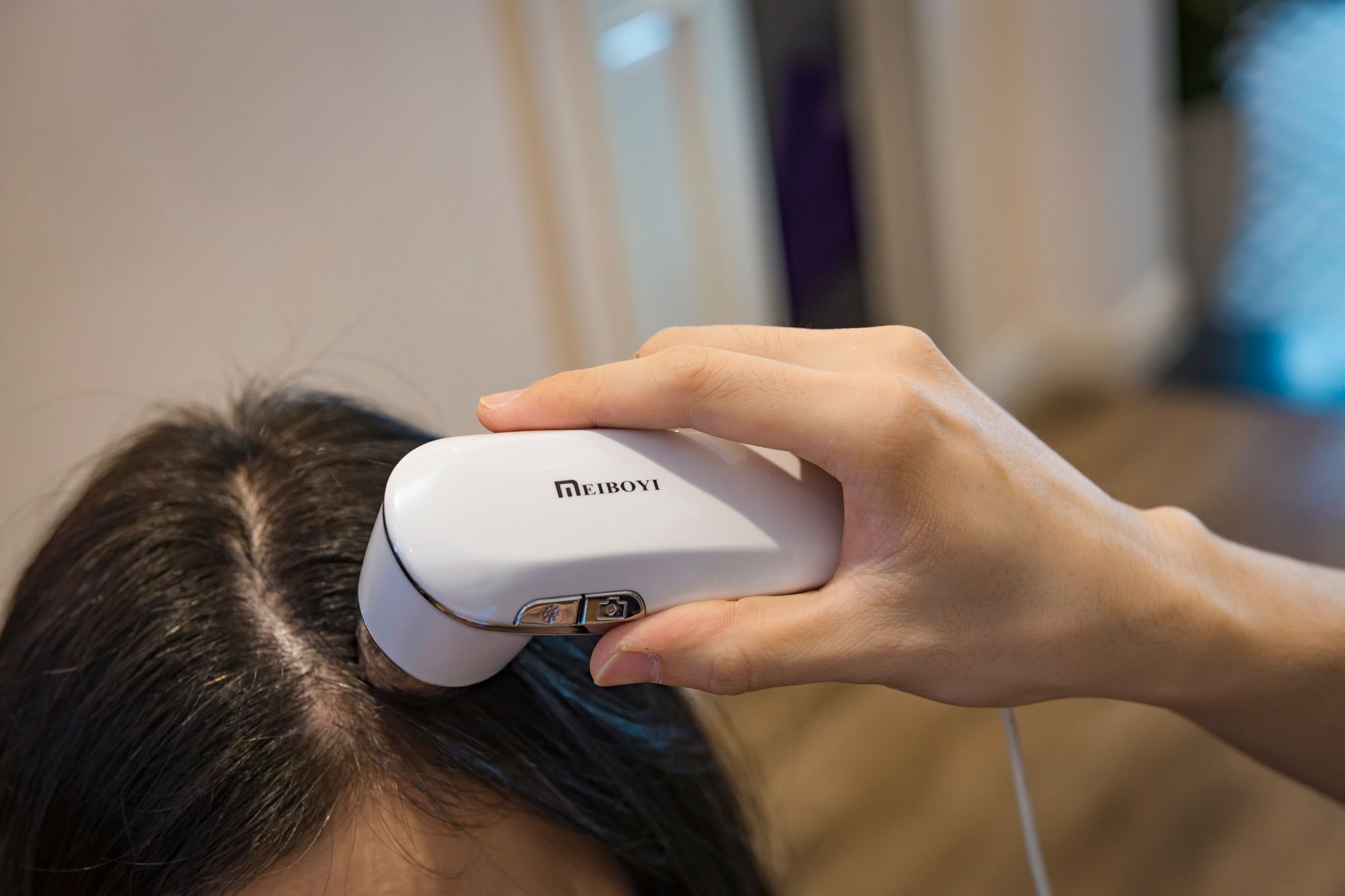
A dermatologist usually starts by looking at the pattern: where the hair is thinning, how fast it is happening and what came before. A useful tool here is trichoscopy, a magnified examination of the scalp and hair shafts with a special camera. Your own observations at home are just as valuable.
Scenario 1: slow thinning (female pattern hair loss)
What it looks like
The parting gets wider, the crown starts to show through, and your ponytail feels thinner, while the hairline at the front usually stays where it was. It develops slowly, over years. This is female pattern hair loss (FPHL), also known as androgenetic alopecia in women.
How common it is after menopause
A Thai study published in the journal Menopause in 2022 examined 178 women aged 50 to 65, using standardised photographs and trichoscopy. Dermatologists found female pattern hair loss in 52% of them. In three out of four of those women, it was mild, stage one. In other words, it is most often caught at an early point, when there is still plenty to preserve.
The link with weight and metabolism
The most interesting finding came after the researchers adjusted for age and family history. Only one factor remained significant: a body mass index (BMI) of 25 or higher. Women in this group had roughly 2.6 times higher odds of female pattern hair loss.
The way to read this: “Genetics sets the tendency, and metabolism decides how strongly it shows.” It isn't a verdict. It's biochemistry, which means some of it can be worked with.
Scenario 2: hair falling out in clumps (telogen effluvium)
What it looks like
This one is sudden. Hair comes out all over the head, and you find it on the pillow, in the shower drain and on your brush. Typically it starts 2–3 months after a trigger: an illness, surgery, severe stress, rapid weight loss, iron deficiency or a change of medication. This is telogen effluvium.
The delay is what confuses people. Hair grows in cycles, and a shock to the body pushes many follicles into the resting phase at once. They shed a few months later, so by the time the hair falls out, the trigger may already feel like old news.
The good news
According to a 2026 review in the Cleveland Clinic Journal of Medicine, telogen effluvium is usually reversible: the hair gradually grows back. The main task is to find and remove the trigger, not to “treat the hair.” A serum won't help if the cause is low ferritin or a thyroid problem.
When two scenarios overlap
The first two scenarios often happen together. Stress or a deficiency can “reveal” a tendency to pattern thinning that had been quietly in the background. That is one more reason to look for causes rather than only for products.
Scenario 3: a receding hairline and thinning eyebrows (frontal fibrosing alopecia)
This scenario is rarely talked about. The hairline at the forehead and temples moves back, and the eyebrows thin out at the same time. This can be frontal fibrosing alopecia (FFA), a scarring form of hair loss.
In a European series of 490 patients, 95% were women, and 84% of those women were postmenopausal. The diagnosis was often made years late.
Why it needs its own section: in scarring alopecia the hair follicle is replaced by scar tissue and doesn't recover. This isn't a situation for “let's wait six months and see.” If you notice your frontal hairline receding together with thinning eyebrows, it is a reason to see a dermatologist soon.
Where to start: a practical plan
1. Take monthly photos
Once a month, photograph your parting, your crown and your frontal hairline in the same light. You can't track changes by eye, and photos give your doctor real information.
2. Think back 2–3 months
Write down what happened in the two to three months before the hair loss began: illness, surgery, stress, a diet, new or stopped medicines.
3. Discuss basic tests with your doctor
A sensible starting set to discuss is TSH (a thyroid test), a complete blood count, and ferritin and iron. Further tests depend on the situation. If you'd like to understand these markers better, see 7 lab tests women over 45 should check.
4. Look at your metabolism
Waist size, blood glucose and insulin. “Hair and heart share the same targets here.” A body composition scan can show more than the scale; read about what a DEXA body composition scan shows.
5. Choose treatment once the scenario is clear
Evidence-based treatments for female pattern hair loss do exist. But they should be chosen by a trichologist or dermatologist after the scenario is clear, not picked from an advert.
Common mistakes with hair loss
- Starting with a product. Without knowing the scenario, even a good serum may be useless: if the cause is a deficiency or the thyroid, you'll find it in blood tests, not on a shelf.
- Putting it all down to age. “Everyone's hair thins after 50” isn't a diagnosis. Each of the three scenarios has its own cause and its own plan.
- Judging changes by eye. You can't see change in the mirror day to day, which is why monthly photos matter.
- Putting off an appointment when the frontal hairline recedes. With the scarring form, time works against you: a follicle replaced by scar tissue can't be restored.
Frequently asked questions
Why is my hair falling out after 50?
The three most common scenarios are slow female pattern thinning, sudden shedding after a trigger (telogen effluvium) and, less often, frontal fibrosing alopecia, a scarring form. They have different causes and different solutions, so the first step is to work out which one you have.
How common is female pattern hair loss after menopause?
In a 2022 study of 178 women aged 50–65, female pattern hair loss was found in 52%, and in three out of four of them it was mild, stage one.
Will hair grow back after telogen effluvium?
According to a 2026 Cleveland Clinic review, telogen effluvium is usually reversible and hair gradually grows back. The key is to find and remove the trigger, such as low ferritin, a thyroid problem, illness or rapid weight loss.
What tests should I ask for if my hair is falling out?
A reasonable basic set to discuss with your doctor is TSH, a complete blood count, ferritin and iron. Further tests depend on your situation.
When should I see a dermatologist about hair loss?
Soon, if your frontal hairline or temples are receding and your eyebrows are thinning. That can be frontal fibrosing alopecia, a scarring condition in which follicles don't recover. A dermatologist or trichologist should also choose any treatment for pattern thinning.
The bottom line
Hair loss after 50 isn't one problem but at least three, and they need different responses. Slow thinning is common and often caught early. Sudden shedding usually has a trigger and is usually reversible. A receding frontal hairline with thinning eyebrows needs a dermatologist without delay. Start with photos, a timeline and basic tests, then choose treatment once you know which scenario is yours.
If you want hormones, metabolism and lab results looked at together, that is the logic of the Personalised Method.
Want to understand what's behind your symptoms? Apply for a Strategic Session.
Sources
- Chaikittisilpa S et al. Prevalence of female pattern hair loss in postmenopausal women: a cross-sectional study. Menopause, 2022. doi.org/10.1097/GME.0000000000001927
- Bergfeld WF, Mendez D. Shedding: An updated guide to a common cause of hair loss. Cleve Clin J Med, 2026. doi.org/10.3949/ccjm.93a.26008
- Kanti V et al. Frontal fibrosing alopecia: demographic and clinical characteristics of 490 cases. JEADV, 2019. doi.org/10.1111/jdv.15735
- Walker CW et al. Hair loss: a systematic approach to evaluation, diagnosis, and management. JAAPA, 2026. doi.org/10.1097/01.JAA.0000000000000405
This article is for educational purposes only and does not replace medical advice.


Apply for a Strategic Session
A short application. I will reply personally within 1–2 working days.